How It Works: Machine Learning
Machine learning powers Vincent by organizing over 1 billion legal documents through vector search. Learn how this AI technology finds relevant, accurate, and legitimate sources through conceptual searches rather than keyword searches—and why it matters for your practice.



A lawyer has three days until trial and needs cases on qualified immunity in excessive force claims—across circuits and across decades. Traditional keyword searches return thousands of results, and most are irrelevant. Hours disappear into manual sifting, with the constant fear of missing the one case that would perfectly encapsulate their argument.
What if there was a way to search by meaning instead of just keywords?
There is. That conceptual understanding is powered by machine learning—the invisible infrastructure working behind every Vincent search.
Try AI That Searches By Meaning
What is Machine Learning?
Machine learning is how AI learns patterns from data without being explicitly programmed for each specific task. Instead of writing rules like “if X, then Y,” the system is shown thousands of examples and figures out the patterns itself.
Think of it like this: Machine learning is like teaching a junior associate to review contracts. At first, you review every contract together, explaining what makes certain clauses problematic. After the associate has reviewed enough contracts, they begin to spot the problematic clauses themselves—and they get better each time.
The key distinction is that traditional programming tells the computer exactly what to do. Machine learning shows the computer examples until it learns to identify patterns.
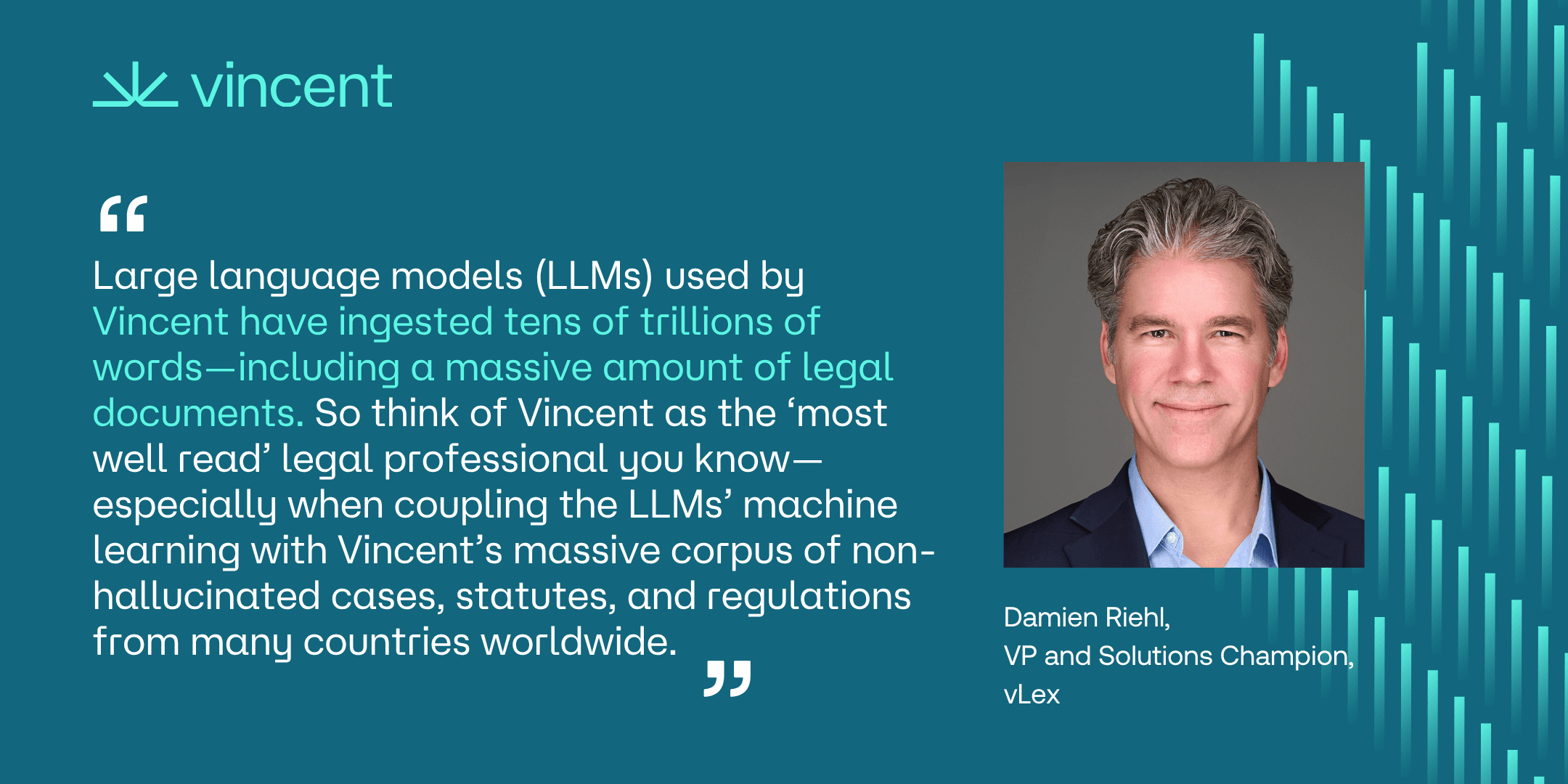
“Large language models (LLMs) used by Vincent have ingested tens of trillions of words—including a massive amount of legal documents,” explains Damien Riehl, vLex VP and Solutions Champion. “So think of Vincent as the ‘most well read’ legal professional you know—especially when coupling the LLMs’ machine learning with Vincent’s massive corpus of non-hallucinated cases, statutes, and regulations from many countries worldwide.”
How Machine Learning Works
To understand how machine learning powers legal research, it helps to understand the general process behind any machine learning system—from development to deployment.
The Training Process
Machine learning follows a structured development path:
- Data Collection: Gather thousands of examples
- Pattern Recognition: The algorithm finds mathematical relationships between data points
- Model Creation: These patterns are encoded into a “model” (essentially a mathematical formula)
- Testing & Validation: The model is tested on new data to verify accuracy
- Deployment: The trained model processes new information
Why Legal Data Quality Matters
The quality of training data directly impacts the quality of predictions (e.g., “garbage in, garbage out”). Legal-specific training data produces legal-specific accuracy, while generic training data produces generic results.
Have you ever used general-purpose AI platforms, checked a source, and discovered it was Wikipedia or a Reddit thread? General AI might be sourcing its legal answers from similarly untrustworthy sources because it was trained on the open web rather than authoritative legal materials.
Vincent’s retrieval engine was custom-tuned specifically to retrieve content from vLex’s legal database—a library built over 25+ years from actual cases, statutes, and regulations. Rather than relying on generic internet text, Vincent was designed to find and retrieve authoritative legal materials as optimally as possible.
Predictions vs. Certainty
Machine learning provides probability and relevance levels, not certainty. The technology excels at pattern recognition and identifying likely matches, but lawyers still need to exercise professional judgment when handling the results.
Where Machine Learning Powers Vincent
While Vincent utilizes several different types of AI, including agentic AI and generative AI, each type is functional only because they are supported by machine learning. Machine learning is the bedrock that Vincent’s core systems are built upon.
Behind-the-Scenes Data Foundation
Long before a lawyer asks Vincent a research question, machine learning has done extensive work preprocessing the data. This isn’t happening during searches—it happened during the engineering and development of Vincent’s database infrastructure.
Machine learning cleans and classifies the underlying data from vLex’s legal database. This preprocessing transforms raw legal information into structured data, creating metadata that makes everything searchable and effective. The system identifies case types, extracts party names, tags jurisdictions, and classifies legal issues—turning unstructured legal text into organized, searchable information.
Our Custom Retrieval Engine
When asking a research question, Vincent doesn’t search the internet. The search goes to a carefully curated legal database using a custom-built machine learning retrieval engine.
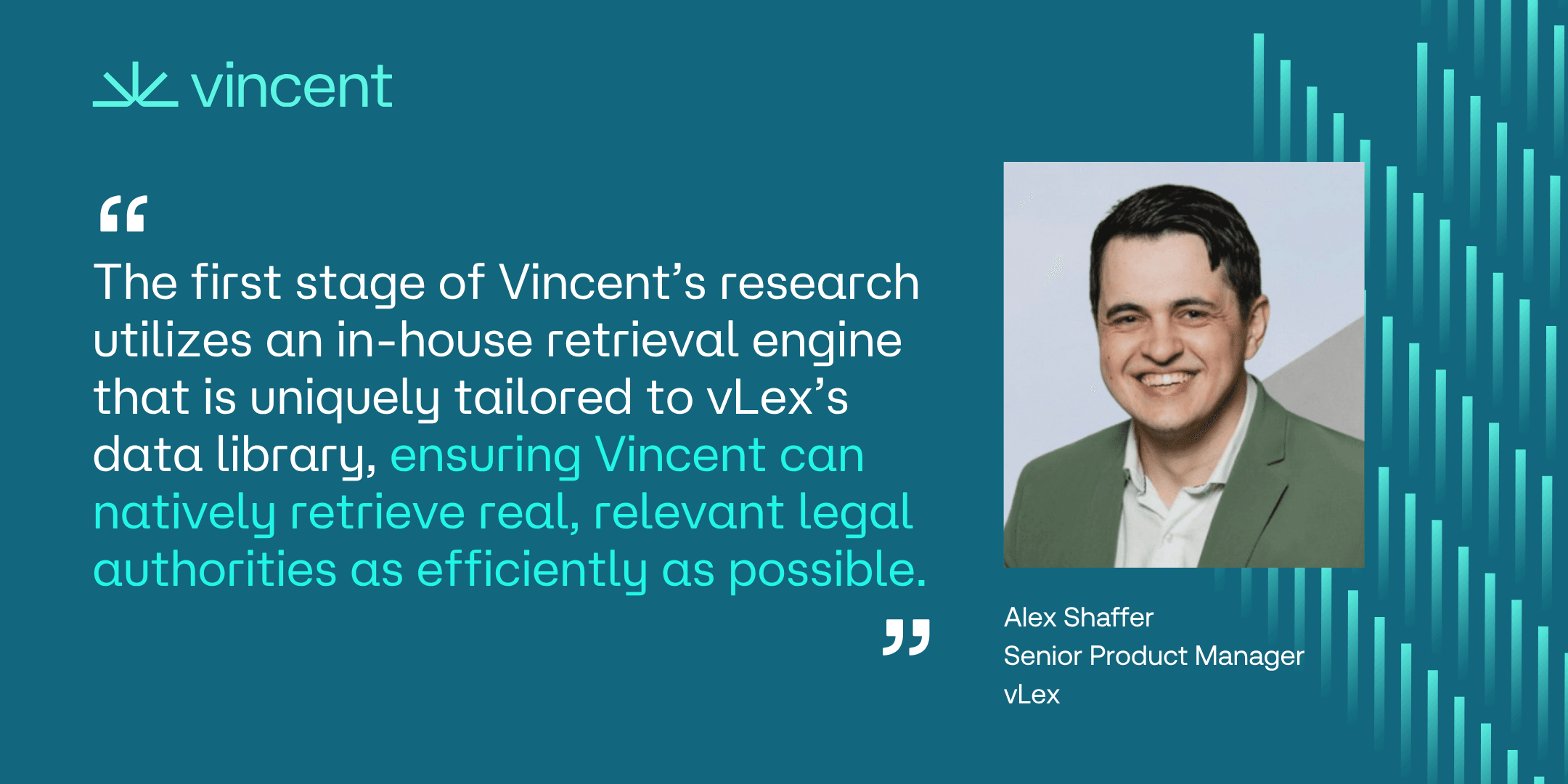
“The first stage of Vincent’s research utilizes an in-house retrieval engine that is uniquely tailored to vLex’s data library, ensuring Vincent can natively retrieve real, relevant legal authorities as efficiently as possible,” explains Alex Shaffer, Vincent Product Manager.
This custom-built system was designed to recognize how legal concepts relate to each other and how lawyers search for information. The retrieval engine uses what’s called RAG—retrieval-augmented generation—meaning Vincent retrieves real legal authorities first, then generates responses based exclusively on those sources. Vincent only cites authorities sourced daily by vLex’s global content teams—ensuring every memo is grounded in actual, current legal materials rather than the foundation model’s generic training data.
Vector Search & Embeddings
Imagine a three-dimensional city map where legal cases are positioned like buildings based on what they’re about. Employment discrimination cases cluster in one neighborhood. Supreme Court precedents stand tall in prominent districts. Contract disputes over force majeure sit on the same block because they deal with similar concepts.
A case about “vehicular accidents” sits right next to cases about “automotive collisions,” even though they use different words, because machine learning understands they refer to the same legal issue. When asking Vincent a research question, the system drops a pin on this map and instantly finds everything in the surrounding neighborhood—cases that might never surface through keyword searches alone.
This technology uses numerical vectors called “embeddings” that represent the meaning of cases. If Case A discusses vehicular accidents and Case B discusses automotive collisions, a mathematical score is applied to both concepts, positioning those cases near each other in the database. The system can then identify relationships between cases across the entire database faster and more comprehensively than any manual research process.
Because of machine learning, the system finds relevant authorities without searching every single document. It locates the relevant neighborhoods based on conceptual similarity, reduces the risk of missing key precedents, and searches by topic and subject rather than requiring exact keyword matches.
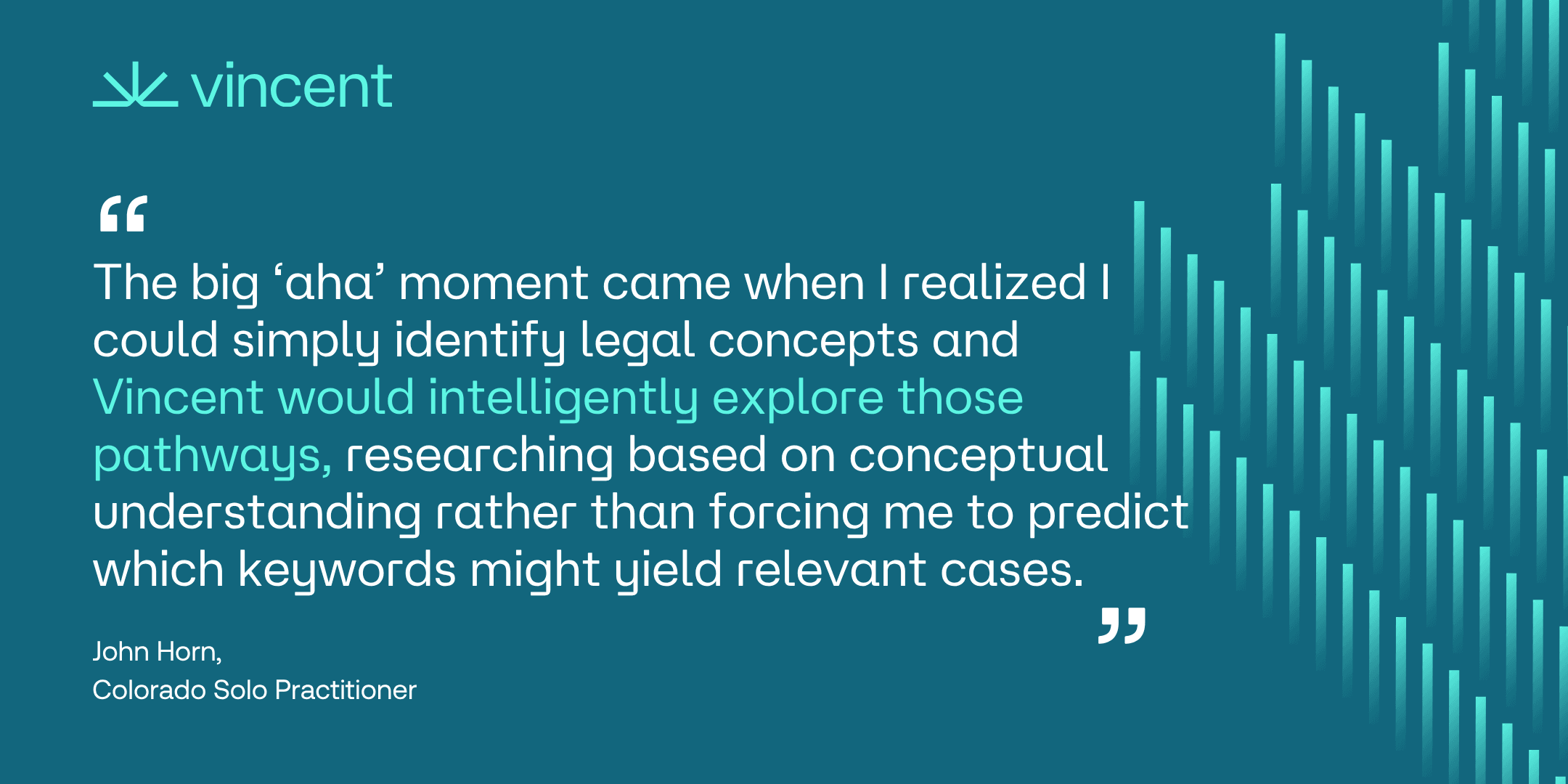
Solo practitioner John Horn experienced this conceptual search approach firsthand: “The big ‘aha’ moment came when I realized I could simply identify legal concepts and Vincent would intelligently explore those pathways, researching based on conceptual understanding rather than forcing me to predict which keywords might yield relevant cases.”
Cross-Language Capabilities
Because embeddings represent meaning mathematically rather than linguistically, they work across languages. The same technology that clusters “vehicular accident” with “automotive collision” can find similar concepts across Spanish, Portuguese, French, and other languages—despite different translations. This makes Vincent’s international database truly searchable across jurisdictions and languages simultaneously.
Relevance Scoring: Transparency in Action
Machine learning does more than just find sources—it evaluates how relevant those sources are to the specific question. Vincent only cites sources with 70% or higher relevance in their applicability. The relevance score for each source is visible, and if the user disagrees with a source Vincent selected, it can be removed. Vincent will rework the memo without any reliance on the contents of the user-removed authority.
This transparency and control ensures that lawyers maintain professional judgment while benefiting from machine learning’s pattern recognition capabilities.
Why This Matters for Your Practice
Legal AI’s machine learning approach has practical implications for how lawyers conduct research and understand their tools.
Professional Competence and Understanding Your Tools
Understanding how research tools work has become increasingly important for professional competence. Machine learning is the foundation that makes other AI capabilities possible—retrieval must work before generation can happen, and quality inputs produce quality outputs.
Vincent’s approach reflects this principle. The generative AI that writes memos depends entirely on the machine learning that finds the sources. The custom-built, legal-specific machine learning retrieval engine ensures the foundation is solid before a single word is written.
The Data Advantage
Vincent’s machine learning was trained on curated legal content from vLex’s database of over 1 billion documents across 100+ jurisdictions. The training data consisted of actual cases, statutes, regulations, and court records—legal materials from authoritative sources, not unregulated websites.
When the quality of AI depends directly on the quality of training data, data governance and transparency become competitive advantages.
The Invisible Infrastructure
Machine learning is the invisible infrastructure powering Vincent’s speed and accuracy. While the polished memo Vincent generates is visible to the user, machine learning and RAG have already worked behind the scenes to find the most relevant authorities across jurisdictions.
The many layers of AI within Vincent work together like the gears in a wristwatch. Machine learning organizes the legal universe, preprocessing and classifying documents so relevant authorities can be found. Agentic AI determines how to approach each question, coordinating which tools and workflows to deploy. And Generative AI synthesizes the retrieved authorities into a coherent legal analysis. Each layer depends on the others, but without machine learning accurately finding and organizing the right legal sources, none of the other layers can function properly.
Ready to experience legal AI that combines machine learning, generative AI, and agentic AI—all engineered specifically for lawyers?
Authored by
Sierra Van Allen
Share this post